

By Karen Van Sickler, Co-Owner of Pampered Pets Inn
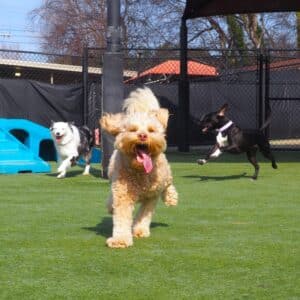
We feel that every dog visiting us, whether for a day or weeks at a time, benefits from socialization and exercise. As a result, our Lodging services include the same group play as our Daycare program. Since our company’s founding in Mooresville, NC, in 2007, we’ve been selecting the appropriate playmates for our guests to ensure a healthy, happy, and safe experience.
For some dogs, this assignment is fairly straightforward. For others, it may take several attempts to fully understand their needs. Breed, environment, age, health, and temperament all play an important role in defining a dog’s behavior. On a peak day, we may have more than 10 different play groupings based on the characteristics of our guests. While not an exact science, there are a number of indicators that help us match dogs successfully. Leveraging industry best practices where available, we’ve created our own model for play group assignments.
Understanding How Energy Level Defines Play Groups
In addition to size considerations in creating play groups, we use three categories to capture energy level: Calm, Active, and Balanced. Calm dogs tend to prefer exploring on their own, receiving attention from handlers, and spending time relaxing in the yards, while Active dogs typically have higher energy, play harder, and are more “talkative.” Balanced dogs combine Calm and Active traits: they take turns chasing and playing, take breaks to self-regulate, and adjust their playstyle to others in the group.
How Pampered Pets Inn Evaluates and Matches Dogs for Safe Group Play
Our Pet Behavior Coaches are the dog handling and behavior experts on our team. They have progressed through Basic, Intermediate and Advanced levels of our Pet Care Technician training and are responsible for performing the evaluations as well as creating the daily play lists.
The Behavior Assessment is a carefully orchestrated process of observation and interaction where we observe how each dog interacts with other dogs and our staff. For first-time guests, the process begins with a one-on-one introduction in the pet’s suite, allowing them to acclimate to their surroundings. As they grow more comfortable, they’re taken to the play yards and gradually introduced to other pet guests, where we continue the assessment. In addition to energy level, we evaluate their comfort level, communication style, tolerance of other dogs, mounting behavior, greeting posture, dominance level, play behaviors, roles with a group, and toy behavior.
Play looks different for each dog; however, some traits and behaviors are universally recognized as positive (Green) or concerning (Yellow / Red).
- Green behaviors include a soft, loose body posture, fluid movements, a neutral or gently wagging tail, and brief sniffing followed by disengagement. Encounters look relaxed and easy, with no obvious tension between the dogs.
- Concerning behaviors include a stiff posture, “whale eyes” (hard stares), raised hackles, and a high, tight tail. These behaviors typically indicate stress or discomfort, but they don’t necessarily mean a dog will be reactive. They are just warning signals.
This information determines the playstyle assignment, staff handling experience needed, and handling warnings that will us help manage the dog’s behavior.
For returning guests, we repeat the behavior assessment process at key developmental points in their lives to ensure their play group assignments evolve as their needs do. For altered pets, this results in new behavior assessments every three years.
Additional Controls to Ensure Safe Play
A thorough behavior assessment doesn’t guarantee that there won’t be issues, however. Additional techniques we employ include:
- Playgroups are structured to never exceed 10 dogs per staff member.
- We assign staff to actively supervise playgroups based on their expertise and the playgroup’s needs (Basic, Intermediate, Advanced).
- A Pet Behavior Coach is available daily for coaching and staff questions about specific dogs and behaviors they may need assistance with in the moment.
- Our Dog Trainers assess dogs who are struggling with group play and provide options to staff and pet parents.
How Pet Owners Can Prepare Their Dog for a Positive Group Play Experience
The best way to help your pet be successful when interacting with other dogs is to ensure they are comfortable, confident, and happy. This includes:
- Implementing Breaks. Teaching your dog to take breaks to check in with themselves or disengage from a situation is imperative. Hyper-fixation and tiredness can lead to tension, discomfort, and stress.
- Ensuring they are fulfilled at home. Playgroups are most beneficial when they complement regular walks and mental enrichment. If your pet is struggling during socialization, this can indicate a need for additional outlets throughout the week.
- Training and reinforcing behaviors. Consistent training at home enhances what your pet practices in the playgroup. Rewarding positive behaviors during social interactions builds confidence and deepens your bond.
- Consistency. Bring them regularly for daycare or lodging, or find friends in your community who have well-socialized dogs that are a good fit for your dog. Be purposeful in choosing playmates based on your dog’s behavior.
When Group Play May Not Be the Right Fit
Sometimes we know right away that a dog isn’t a good fit for play groups. Other times, it becomes apparent after several visits, if multiple interventions and corrections are necessary, or if problematic behavior begins to appear. Personalities evolve over time, so a young dog who enjoys play may not do so as they age, particularly if they are not regularly exposed to social play. Not all dogs enjoy interacting with other dogs, so a decision to move a dog out of group play isn’t a punishment; it’s an acknowledgement of what is best for the dog. We will fully communicate our reasons to you as well as provide options, such as Individual Play, obedience training, or behavior training with a Lake Norman area partner. We are also happy to work with your dog trainer to share with them what we are seeing.
Each dog is unique. With over 1,000 individual dogs visiting us each year, we’ve built the expertise to understand what behavior is appropriate and where guidance is needed. Together, we can create safe, enriching play experiences that support your dog’s long-term wellbeing. Visit our website to learn more about our Daycare, Lodging, and Dog Training Services.
Last updated: 3/3/2026